
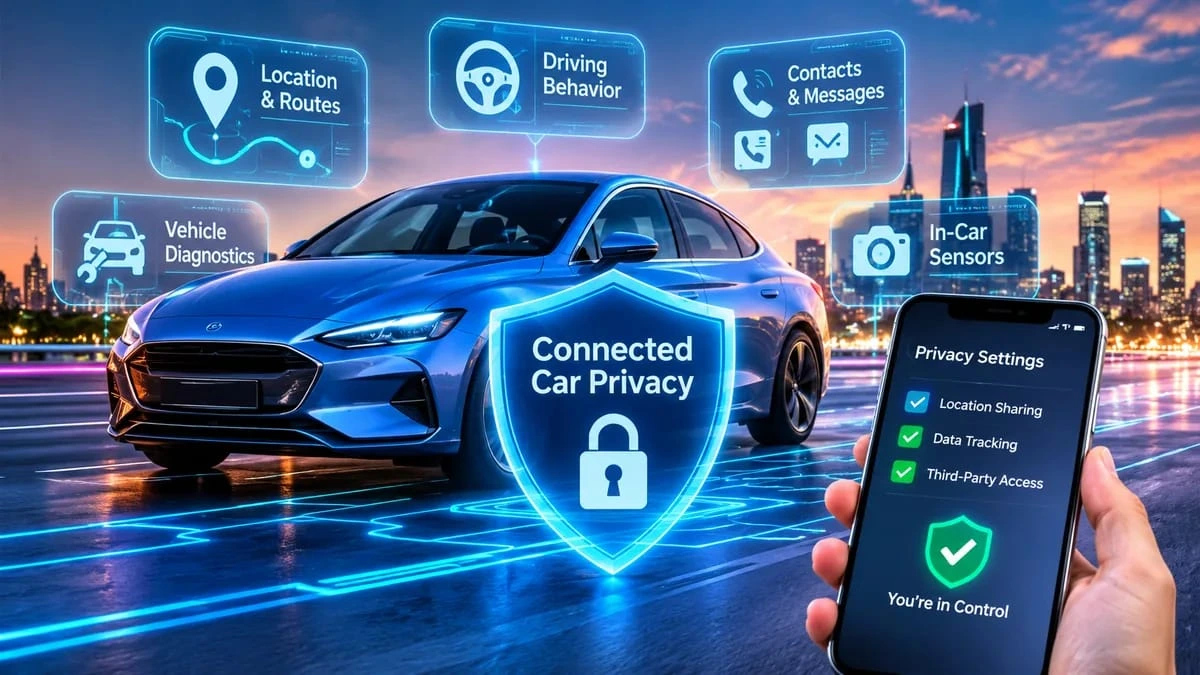
When you pair your smartphone to a modern car, grant an app permission to lock doors remotely, or rely on live traffic updates during a daily commute, your vehicle does much more than transport you from one place to another. Depending on their installed hardware, active services, permissions, and configuration, connected vehicles may process various categories of information—ranging from location coordinates and driving speeds to contact lists and voice recordings.
While these connected features offer genuine convenience, they raise important questions about connected car privacy. Drivers rarely see how their personal information flows from dashboard displays to manufacturer cloud servers and third-party partners. Understanding this digital footprint—and knowing what steps you can take to manage it—is essential for protecting your personal data on the road. For broader insights into digital security, you can also review standard cybersecurity best practices to secure digital operations, as well as explore related topics in our Auto Tech & Mobility archive.
What Is Connected Car Privacy?
Connected car privacy refers to the protection of personal data generated, processed, stored, or transmitted by a motor vehicle equipped with internet access, local wireless networking, or embedded telematics hardware.
Unlike traditional automobiles that operate as isolated mechanical systems, connected vehicles maintain periodic or continuous data links with external infrastructure, mobile applications, and manufacturer cloud platforms, depending on active services and vehicle configuration. Protecting this ecosystem involves ensuring that drivers and passengers retain control over their personal information, location histories, and behavioral telemetry against unauthorized secondary use or surveillance.
How Connected Cars Collect and Transmit Data
Smart cars utilize a multi-layered communication architecture to exchange data across public and private networks, though architecture and hardware configurations vary significantly by manufacturer, model year, and trim level. Many modern vehicles include built-in cellular connectivity via embedded SIMs (eSIMs) to support live traffic updates, emergency calling, infotainment streaming, and remote app control. However, data transmission is not always continuous; behavior depends on vehicle architecture, active services, privacy settings, connectivity, and emergency functions.
Vehicle network architecture differs widely. While many connected vehicles utilize a specialized Telematics Control Unit (TCU) to handle cellular communication and specific telemetry tasks, telematics functions may also be integrated directly into the central infotainment head unit or other onboard modules depending on the manufacturer and model. Furthermore, Global Navigation Satellite Systems (GNSS) like GPS determine geospatial positioning, while Inertial Measurement Units (IMUs) track localized vehicle dynamics, orientation, and acceleration. These distinct sensor streams serve different operational functions.
When data is transmitted externally, selected telemetry may be transmitted to manufacturer or service-provider systems depending on vehicle configuration and connected services. Security protections and encryption depend on the actual communication protocols and implementation. It is important to distinguish locally processed information from information actually transmitted externally. Local wireless protocols such as Bluetooth, Wi-Fi, and USB facilitate direct device pairing, media streaming, and smartphone projection integration (such as Apple CarPlay and Android Auto) where supported by the vehicle software.
What Personal Information Can a Car Collect?
Modern passenger vehicles capture a diverse range of telemetry and behavioral data points during operation, depending on installed equipment packages and active subscriptions:
- Location and Movement Data: Geospatial coordinates, route histories, frequent destinations, parking locations, and vehicle speed profiles.
- Driving Behavior Metrics: Acceleration intensity, harsh braking events, cornering G-forces, steering angles, seatbelt usage, and driver fatigue indicators.
- Vehicle Diagnostics and Health: Battery voltage, tire pressure monitoring system (TPMS) readings, engine operating temperatures, fluid levels, diagnostic trouble codes (DTCs), and odometer mileage.
- Infotainment and Media Usage: Paired mobile device identifiers, contact lists, call logs, text message metadata, voice recognition recordings, browser history, and streaming media preferences.
- In-Cabin Sensor Data: Depending on advanced driver assistance systems (ADAS) or interior monitoring packages, certain vehicles feature driver-attention cameras or seat occupancy sensors designed to monitor alertness or passenger safety. These cabin-monitoring features depend strictly on installed hardware and vehicle configuration and are not standard across all modern cars.
Does Your Car Track Your Location and Driving Behaviour?
Location tracking and behavioral profiling rely on vehicle location services that may use GNSS, navigation systems, and, depending on the service, other network or vehicle data.
Selected telemetry may be transmitted or synced to manufacturer cloud environments depending on the service and vehicle configuration, though implementation varies by architecture and service. Insurance providers, fleet managers, and vehicle manufacturers utilize these analytics streams for usage-based insurance (UBI) programs, predictive maintenance alerts, and driver profiling, raising significant consumer privacy considerations regarding secondary data sharing. Participation in usage-based insurance programmes depends directly on the relevant insurance contract, permissions, and applicable law.
Furthermore, Event Data Recorders (EDRs) record limited vehicle and occupant information around qualifying crash events, generally covering seconds before, during and after a crash. An EDR is not a general-purpose operational log storage device.
Can Your Car Access Smartphone Contacts, Calls and Messages?
Integrating personal smartphones into vehicle infotainment systems exposes personal data if proper precautions are ignored. However, data transfer is not automatic or universal. Contacts, call logs, messages, and other smartphone information may be accessed or stored depending on operating-system permissions, infotainment software, device integration, and user choices. A connected car does not automatically download all smartphone data by default.
If a vehicle is sold, traded in, or rented without performing a proper factory reset or clearing paired device profiles, subsequent drivers or third parties can access sensitive personal information stored locally on the vehicle’s internal flash memory.
Where Is Connected Car Data Stored?
Data collected by smart vehicles is distributed across multiple physical and digital locations:
- On-Vehicle Electronic Storage: Infotainment systems and onboard memory modules may retain locally stored profiles, navigation history, and other vehicle-related information. Event Data Recorders (EDRs), where fitted, serve a different purpose: they record limited vehicle and occupant information around qualifying crash events, generally covering a few seconds before, during, and after a crash. They are not general-purpose operational log storage devices.
- Manufacturer Cloud Servers: Telemetry and user account data may be transmitted or synced to centralized cloud infrastructure hosted by Original Equipment Manufacturers (OEMs) or third-party cloud vendors, depending on the service and vehicle configuration.
- Third-Party Ecosystems: Insurance companies, map providers, roadside assistance networks, and application developers may access specific data feeds subject to consumer consent agreements and manufacturer data-sharing policies.
Who Can Access or Share Your Vehicle Data?
Vehicle data accessibility depends on contractual terms, regional privacy regulations, and individual user permissions. Access is governed by actual service arrangements, legal authority, permissions, and applicable law rather than universal sharing:
- Automotive Manufacturers (OEMs): Process telemetry for warranty servicing, vehicle software improvements, and connected service delivery.
- Authorized Dealerships: Access specific diagnostic trouble codes and maintenance history during servicing visits based on service arrangements and diagnostic tool permissions.
- Service Providers and Insurers: Third-party application developers, mapping services, and insurance companies participating in connected-car or usage-based insurance programs, depending on contractual terms, applicable legal requirements, and whether the owner consented or opted into specific data-sharing arrangements.
- Law Enforcement Agencies: May seek access to vehicle location or crash telemetry through legal warrants, subpoenas, or statutory authorities, subject to regional legal protections.
The Hidden Privacy Risk: Passengers, Rental Cars and Previous Owners
Modern vehicles frequently process data from multiple occupants, rental customers, and secondary users whose privacy expectations may differ from the primary registered owner.
- Passengers and Non-Primary Drivers: Voice commands, connected smartphones, and navigation destinations entered by passengers or secondary drivers may be stored locally or transmitted to connected services depending on the vehicle, account, settings, and software.
- Rental and Shared Vehicles: In rental or fleet environments, users often pair personal smartphones for navigation or media streaming. Failing to unpair devices or clear local profiles before returning a rental vehicle leaves call logs, contact lists, and location history exposed to subsequent drivers.
- Used-Car Buyers and Previous Accounts: A used-car buyer may inherit a vehicle still linked to the previous owner’s connected services or mobile app account. Conversely, a factory reset may remove locally stored infotainment data and user profiles, depending on the vehicle and manufacturer. However, it does not automatically delete information already transmitted to and stored in manufacturer or third-party connected-service accounts. Previous owners must explicitly terminate services and request cloud data deletion through manufacturer account portals where available.
- Empirical Insights: A policy-level study by researchers examining the U.S. privacy policies of 17 major automotive manufacturers highlighted complex data-sharing practices and varying transparency regarding secondary user data collection and third-party data sharing (USENIX VehicleSec 2025). This study examined privacy disclosures rather than performing a worldwide technical audit of actual vehicle telemetry.
Can Connected Cars Be Hacked?
The expansion of digital interfaces creates potential security considerations across modern vehicle architectures, though a theoretical attack path is distinct from a confirmed vulnerability or demonstrated real-world attack. Security researchers have demonstrated academic proof-of-concept exploits showing how poorly isolated infotainment units could theoretically interact with vehicle networks. For example, historical research demonstrated remote exploitation of an unaltered 2014 Jeep Cherokee via vulnerable Uconnect software interfaces (IOActive Research, US-CERT Vulnerability Note VU#819439). However, these demonstrations involved specific vehicle systems and configurations; they do not imply that all modern vehicles share the same vulnerabilities or security profiles.
Securing a connected vehicle requires understanding its underlying digital subsystems:
- Secure Boot and Hardware Security Modules (HSMs): Secure boot helps verify the integrity and authenticity of software during startup, while hardware security modules help protect cryptographic keys and security operations where fitted and implemented. Firmware integrity verification is distinct from communication confidentiality; cellular communication security requires appropriate encryption, authentication, and network protections, the implementation of which varies by manufacturer and system.
- CAN Bus Segmentation: Vehicle network isolation varies by manufacturer, model, platform, and vehicle generation. Modern vehicle design often incorporates security gateways and domain controllers to isolate high-bandwidth infotainment networks from safety-critical powertrain and braking buses, though implementation depth differs widely.
- Remote Access and Digital Keys: Smartphone companion applications allow owners to lock doors, locate vehicles, and utilize digital smartphone keys via Near Field Communication (NFC) or ultra-wideband (UWB) protocols according to the supported vehicle implementation. Digital-key systems do not necessarily use identical cloud-token and encryption architectures.
Vehicle Data Privacy Laws Around the World
Privacy and data protection obligations vary significantly by geographic jurisdiction:
- European Union: Governed by the GDPR and guidance from the European Data Protection Board (EDPB), which distinguishes personal data from non-personal vehicle data. Processing must rely on valid lawful bases (such as performance of a contract, legitimate interests, or consent) depending on the purpose and circumstances; explicit consent is not the sole universal legal basis for data processing.
- United Kingdom: Governed by the UK GDPR and Data Protection Act requirements overseen by the Information Commissioner’s Office (ICO), which addresses location privacy and device tracking transparency.
- United States: Lacks a single comprehensive federal automotive privacy law covering every data practice. Instead, protection relies on state-level privacy statutes (such as the California Consumer Privacy Act) and Federal Trade Commission (FTC) enforcement actions against deceptive data practices.
- India: Operates under the Digital Personal Data Protection (DPDP) framework. Based on the official Gazette notification G.S.R. 843(E) dated 13 November 2025, the provisions specified for the one-year commencement stage—including Section 6(9) and Section 27(1)(d)—commenced on 13 November 2026, while other specified provisions in the eighteen-month stage are scheduled to commence on 13 May 2027 (Official Gazette). This reflects a structured phased rollout rather than making all general data-protection obligations under the DPDP Act operational at once, and it remains separate from the phased commencement schedule of the DPDP Rules.
- International Automotive Cybersecurity Standards: Frameworks such as UNECE UN Regulations R155 (Cybersecurity Management Systems) and R156 (Software Update Management Systems) establish regulatory requirements for vehicle manufacturers within their applicable type-approval jurisdictions. ISO/SAE 21434 provides a complementary automotive cybersecurity engineering standard that supports risk management throughout the vehicle lifecycle, but it is not universally mandatory by itself.
How to Protect Your Connected Car Data
Vehicle owners can take practical steps to minimize privacy risks and enhance security:
- Audit Infotainment Permissions: Review privacy settings within the vehicle infotainment system and restrict unnecessary sharing of contacts, location history, and diagnostic telemetry.
- Manage Paired Devices: Regularly check paired Bluetooth and USB devices, and remove old smartphones from the vehicle directory.
- Perform Factory Resets Before Transfer: Always execute a full system wipe and delete user profiles before selling, returning, or trading in a leased vehicle. Note that factory reset functionality varies by vehicle and manufacturer; while a reset may remove locally stored data, it does not automatically delete cloud or connected-account records. Owners should follow the specific manufacturer’s ownership-transfer and data-deletion procedure.
- Secure Companion Apps: Enable multi-factor authentication (MFA) on manufacturer smartphone apps and use strong, unique passwords where supported.
- Keep Software Updated: Install official manufacturer firmware and software updates promptly to patch security vulnerabilities. Note that over-the-air (OTA) updates do not eliminate the need for physical recalls, mechanical repairs, or hardware servicing at authorized workshops.
What to Do Before Selling or Returning a Connected Car
Transferring vehicle ownership requires careful removal of personal data to prevent subsequent drivers from accessing sensitive accounts:
- Unlink Connected Services: Remove the vehicle from your manufacturer account portal, revoke authorized drivers, terminate connected services where appropriate, and follow the specific manufacturer’s ownership-transfer and data-deletion procedure.
- Clear Infotainment Data: Navigate to the vehicle settings menu and execute a factory reset according to the manufacturer’s instructions to wipe local storage.
- Uninstall Mobile Apps: Delete the vehicle companion app from your smartphone.
Connected Car Privacy Checklist
Connected-Car Data Collection and Privacy-Control Matrix
Data category Where the data may come from Why it may be collected Who may receive or process it What the vehicle owner can check or control
Location & Route History GNSS/GPS receivers, navigation apps, telematics modems Route calculation, navigation services, traffic analysis, connected-car features OEM cloud servers, map providers, traffic analytics partners Review infotainment location sharing toggles, disable connected navigation services where supported
Driving Behavior Accelerometers, gyroscopes, steering angle sensors, IMUs Safety monitoring, adaptive cruise control, usage-based insurance programs OEMs, insurance partners (if applicable), fleet managers Opt out of telemetry-sharing and UBI programs in vehicle privacy menus
Vehicle Diagnostics TPMS sensors, engine management ECUs, battery monitors Predictive maintenance, warranty validation, regulatory emissions reporting Authorized dealerships, OEM engineering divisions Check service reminder settings and diagnostic data-sharing consents
Infotainment & Media Paired smartphones, USB drives, built-in media apps Media playback, hands-free calling, voice control integration Infotainment operating system, paired device apps Manage Bluetooth permissions, avoid syncing unnecessary contact lists
Connected Smartphone Info Companion apps, USB/Bluetooth tethering Remote vehicle unlocking, climate pre-conditioning, digital keys Manufacturer cloud APIs, mobile operating system Revoke mobile app background permissions, enable multi-factor authentication
In-Cabin Sensor Data Cabin cameras, seat occupancy sensors, driver attention monitors Driver alertness monitoring, airbag deployment adjustments, passenger safety Onboard safety ECUs, local processing units Consult vehicle manual regarding cabin monitoring toggles or sensor shading
Three Owner Checklists
- Before Buying a Connected Vehicle
- Research the manufacturer’s privacy policy and data-sharing disclosure terms regarding telematics collection.
- Inquire whether data-sharing programs (such as insurance tracking) are opt-in or enabled by default.
- Review available physical and digital security features, such as app multi-factor authentication support.
- Check if the vehicle manufacturer provides transparent update lifecycles and cybersecurity patch commitments.
- While Using Connected Vehicle Services
- Periodically audit privacy settings and data-sharing toggles within the infotainment menu.
- Limit smartphone pairing permissions to essential calling and media functions, restricting automatic contact uploads.
- Enable multi-factor authentication on manufacturer mobile apps and customer web portals where supported.
- Install official manufacturer software updates promptly to maintain system security.
- Monitor companion app permissions on your mobile phone to restrict unnecessary background location access.
- Before Selling, Returning or Transferring Ownership
- Terminate connected service subscriptions, remove the vehicle from your manufacturer account portal, and follow OEM data-deletion instructions.
- Perform a factory reset on the infotainment head unit following the manufacturer’s specific procedure to erase local personal data.
- Delete all paired smartphones, contact lists, call logs, and saved navigation destinations.
- Uninstall the vehicle companion app from your mobile device.
Common Myths and Misunderstandings
- Myth: Turning off the infotainment screen stops all vehicle data collection.
- Fact: Background telematics controllers can operate independently of the infotainment display in some vehicle architectures, transmitting operational data based on vehicle architecture, active services, and cellular connectivity.
- Myth: All connected car data is completely anonymous.
- Fact: Detailed location and time patterns may create re-identification risks, allowing researchers or entities to link anonymous telemetry streams to individual profiles under certain conditions.
- Myth: Over-the-air updates eliminate the need for physical service visits.
- Fact: While OTA updates resolve many software flaws, critical hardware-level ECU faults, mechanical recalls, or physical part replacements still require workshop intervention.
Frequently Asked Questions
What is a Telematics Control Unit (TCU)?
The TCU is an embedded hardware module inside many modern vehicles that manages specific wireless communication and telematics tasks, though overall network architectures and gateway designs vary widely by manufacturer.
Can car manufacturers sell my driving data to third parties?
Data practices vary across manufacturers. Laws and privacy policies distinguish between data sharing, disclosure, and legally defined data sales, and specific sharing arrangements generally depend on contract terms and whether the owner consented or opted in.
How do I delete my personal data from a used car?
Wiping local storage requires navigating to the infotainment system settings menu to execute a factory reset according to the manufacturer’s instructions. Because reset functionality varies by vehicle and manufacturer, owners must also follow the specific manufacturer’s ownership-transfer and data-deletion procedure to address cloud and account-stored records.
Does turning off GPS location sharing stop all tracking?
Disabling in-car GPS navigation prompts may stop infotainment map tracking, but some connected services may use network-based location information or continue specific telematics functions, depending on the vehicle and active service configurations.
Are connected cars vulnerable to remote hacking?
While historical demonstrations—such as the 2015 Jeep Cherokee research involving vulnerable Uconnect software—proved remote exploit paths under specific test conditions, real-world vulnerability levels vary significantly by vehicle make, model, and software generation.
Do data privacy laws apply equally to cars worldwide?
No. Privacy protections vary significantly across regions, with distinct legal frameworks governing the EU, UK, US, and India.
Conclusion
Connected car technology delivers convenience, safety enhancements, and entertainment capabilities, but it transforms automobiles into active data-collection nodes depending on vehicle equipment and active services. Understanding how vehicles communicate, what telemetry is gathered, and how manufacturer cloud systems process data empowers vehicle owners to take control of their digital privacy. By adopting disciplined device management, reviewing consent settings, and adhering to cybersecurity best practices, drivers can enjoy modern automotive innovations while safeguarding their personal information.
Sources and Further Reading
- Australian Cyber Security Centre (ACSC) – Introduction to Connected Vehicles: https://www.cyber.gov.au/publication/introduction-to-connected-vehicles
- European Data Protection Board (EDPB) – Guidelines 01/2020 on Processing Personal Data in the Context of Connected Vehicles: https://www.edpb.europa.eu/documents/guideline/guidelines-012020-on-processing-personal-data-in-the-context-of-connected_en
- USENIX VehicleSec 2025 Research on Privacy Policies: https://www.usenix.org/conference/vehiclesec25/presentation/moore-poster
- National Highway Traffic Safety Administration (NHTSA) – Event Data Recorder: https://www.nhtsa.gov/research-data/event-data-recorder
- IOActive Research on Remote Exploitation of an Unaltered Passenger Vehicle: https://www.ioactive.com/remote-exploitation-of-an-unaltered-passenger-vehicle/
- US-CERT Vulnerability Note VU#819439 (Jeep Uconnect): https://www.kb.cert.org/vuls/id/819439
- United Nations Economic Commission for Europe (UNECE) – UN Regulations on Cybersecurity (R155) and Software Updates (R156): https://unece.org/transport/vehicle-regulations/cyber-security-and-software-updates
- Official India Gazette Notification on DPDP Act Implementation: https://egazette.gov.in/WriteReadData/2025/267647.pdf
- Government of India – Digital Personal Data Protection Rules, 2025, Official Gazette Notification G.S.R. 846(E): https://egazette.gov.in/WriteReadData/2025/267650.pdf
- Google Search Central – Creating Helpful, Reliable, People-First Content: https://developers.google.com/search/docs/fundamentals/creating-helpful-content
Aisa check karo FIR mujhe batao aur aaj cal main isliye nahin rahega aajkal ke andar Aisa bahar hai kya Jaise Mera title Ho Gaya matter discussion Ho Gaya focus ki bad Ho Gaya future image alternative tax Ho Gaya yah sab kuchh artical ke andar nahin rahega yah sab bahar rahega ab invest karke mujhe bataiyega
1 thought on “Connected Car Privacy: What Data Your Car Collects and How to Protect It”